
Trauma Lab Keep Him Alive Challenge: Survival Guide
Trauma lab keep him alive challenge guide for v1.19: learn key controls, manage bleeding, use medical tools, and avoid treatment mistakes in your next run.
Jump to
How to Start the Keep Him Alive Challenge
The Trauma Lab keep him alive challenge puts the game’s medical tools at the center of the action. Keeping the subject alive means paying attention to bleeding, internal injuries, and the effects of the drugs you use. Start the Trauma Lab keep him alive challenge with H, its default sandbox binding in v1.19, and learn what each treatment actually changes.
The key distinction is between fixing a visible wound and fixing everything underneath it. A stitched opening can still hide internal bleeding. Saline can raise blood pressure without replacing oxygen-carrying blood. A shock targets a particular heart rhythm rather than repairing every cause of collapse.
Trauma Lab is a game simulation; these mechanics are for gameplay, not real medical treatment.
Before starting, familiarize yourself with the sandbox interface. Story mode uses different controls, and key bindings are remappable.
| Sandbox action | Default key in v1.19 |
|---|---|
| Challenge: keep him alive | H |
| Medicine category | 4 |
| Open tool menu | Tab |
| Previous / next tool in the tab | Q / E |
| X-ray | X |
| Examine with X-ray | Z |
| Organ chart | C |
| Heart monitor size | M |
| Next body view | V |
| Options | O |
Use the tool menu to locate your treatment options before you need them. Keep the diagnostic controls within reach, too: identifying an injury helps you avoid treating the same visible wound repeatedly while another problem continues.
Read the Injuries Before Choosing a Treatment
For the Trauma Lab keep him alive challenge, build your decisions around the injury you can identify. Use X-ray and Examine to inspect the body, then check the organ chart alongside the heart monitor.
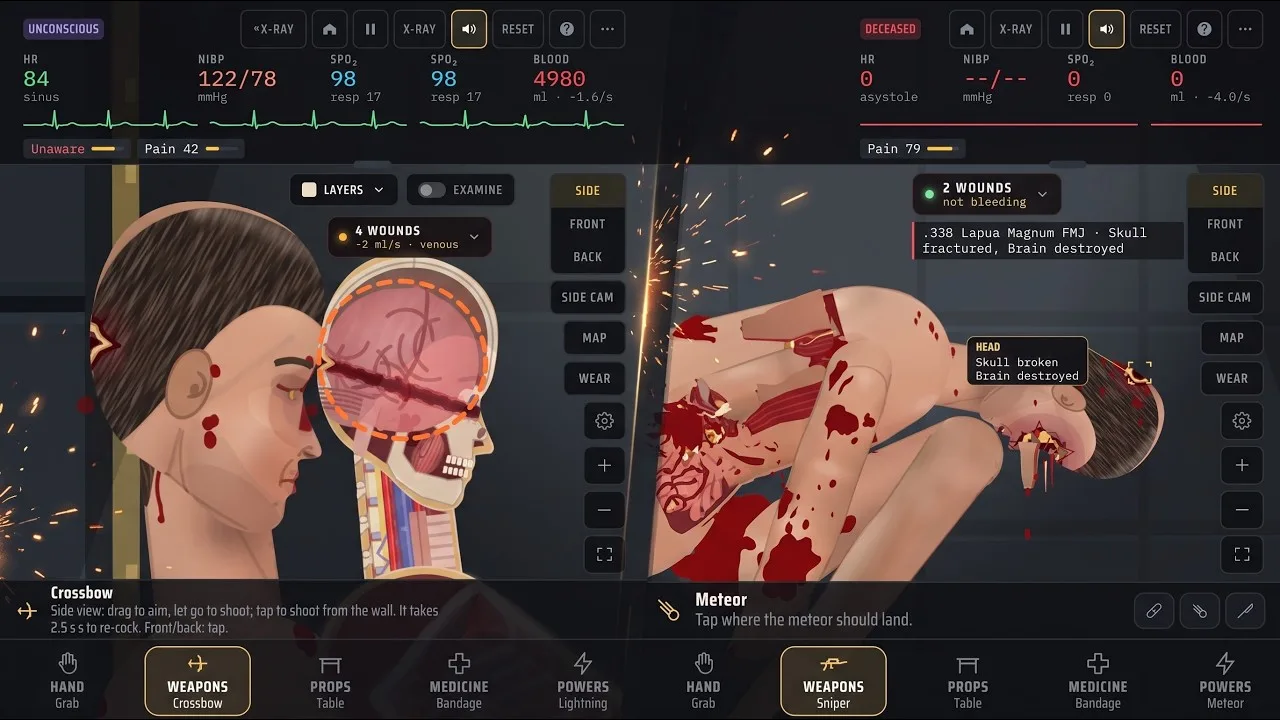
Look beyond the surface. The Suture tool closes a wound and ties off torn vessels there, but deep internal bleeding continues. That makes a clean-looking exterior a poor reason to stop checking the subject.
Switch between side, front, and back views when you need another angle. The default V binding cycles through them. Avoid unnecessary dragging with Grab: it moves body parts and objects, while Move handles camera panning and zooming.
Use this inspection routine:
- Check visible wounds and burns.
- Inspect beneath the surface with X-ray and Examine.
- Check the organ chart for internal damage.
- Watch the heart monitor while choosing the next tool.
- Recheck after treatment instead of assuming one action solved everything.
Match the tool to the problem you find. A lodged bullet has a dedicated removal tool, while damaged organs and fractured bones have separate repair options.
Keep the current selection in mind before tapping the subject. Medicine, weapons, props, and powers occupy different categories, and the same click can have very different consequences depending on what is equipped. Press 4 to select Medicine, then choose the intended tool.
The useful habit here is deliberate input: inspect, select, apply, and inspect again. Give each action a clear purpose rather than cycling through treatments without checking their effects.
Control Bleeding and Replace Lost Blood
Bleeding gives the Trauma Lab keep him alive challenge much of its urgency. Several tools address it, but their descriptions draw clear boundaries between surface wounds, deep cavities, limb bleeding, and internal damage.
| Tool | In-game function | Detail to remember |
|---|---|---|
| Bandage | Dresses a wound or wraps wounds and burns beneath a dragged strip | Tap to dress; drag to wrap |
| Suture | Closes a wound and ties off torn vessels at that wound | Deep internal bleeding continues |
| Gauze pack | Packs deep wounds, craters, and stumps | Works on injuries that cannot be stitched |
| Tourniquet | Clamps bleeding vessels below the strap on an arm or leg | Its effect applies below the strap |
| Surgery | Repairs internal bleeding and removes bullets in the selected body part | Sedate the subject first |
| Blood | Transfuses 500 mL of O-negative whole blood | Replaces blood directly |
| Saline | Adds 500 mL of volume and raises blood pressure | Dilutes oxygen-carrying blood |
Choose Gauze pack for a crater or stump rather than repeatedly attempting to stitch it. Use the Tourniquet on an arm or leg when you need its below-the-strap bleeding control. For internal bleeding, select Surgery after sedation.
Blood and saline deserve special attention because both add volume, but their effects differ. The Blood tool gives whole blood. Saline raises pressure while diluting the blood’s oxygen-carrying component.
When practicing, keep bleeding control and replacement as separate decisions. Address the damaged vessels, then assess the need for blood replacement. Repeatedly adding fluid leaves the underlying wound untreated.
TXA also belongs in your bleeding toolkit: its in-game effect slows bleeding. Pair that knowledge with the tools that directly address wounds and damaged vessels.
For a lodged projectile, Forceps removes a gray bullet. Bullets left inside cause pain and slow bleeding. Surgery also removes bullets from the body part being operated on, so consider the internal injury before choosing between those tools.
Avoid turning a wound into a checklist of every available treatment. Pick the tool whose function matches the damage, then check what still needs attention.
Repair Deep Damage, Burns, and Broken Bones
The Trauma Lab keep him alive challenge becomes easier to reason through when you separate wound closure from structural repair. Graft, Surgery, Bone plate, and Transplant each handle different kinds of damage.
| Tool | What it addresses in v1.19 | Application detail |
|---|---|---|
| Surgery | Bleeding vessels, bleeding organs, and bullets | Tap the affected body part after sedation |
| Graft | Large wounds, craters, missing tissue, and stumps | Sedate first; it cleans, ties off vessels, and covers the injury |
| Bone plate | Fractures in limbs, hip, spine, skull, or chest | Sedate before applying |
| Transplant | A body part’s most damaged organ | Tap the relevant body part |
| Transplant | Detached limbs | Tap the stump or detached limb |
| Burn gel | First- and second-degree burns | Tap or rub over burned skin |
| Graft | Third-degree burns | Burn gel alone does not repair these |
Sedation is part of the preparation for Surgery, Graft, and Bone plate. Midazolam provides sedation and calms writhing. Choose it deliberately before those procedures rather than confusing pain relief with sedation.
Bone plate repairs and stabilizes a fracture. The subject can use the limb and stand again once pain allows, so keep pain in mind when judging the result. Repairing the bone and restoring comfortable movement are connected, but the tool description includes both conditions.
For burns, match treatment to depth. Burn gel cools the affected skin, eases pain, stops fluid loss, and heals first- and second-degree burns. Third-degree burns require Graft.
If the subject is actively burning, use the Extinguisher to stop the flames before treating the damaged skin. Hold it over the fire to spray. Lying down also smothers fire in the simulation.
Transplant has several distinct uses. Besides replacing damaged organs and reattaching limbs, it supplies a bone marrow transplant after radiation exposure. Select it for the injury at hand rather than treating it as another wound dressing.
Manage Drugs, Heart Rhythm, and Performance
Drug effects can complicate a Trauma Lab keep him alive challenge attempt. Pain relief, sedation, stimulation, and reversal each do different jobs.
| Drug or tool | In-game effect | Interaction to remember |
|---|---|---|
| Morphine | Strong pain relief; slows breathing | Naloxone reverses it |
| Fentanyl | Fast, potent opioid | Excess stops breathing; Naloxone reverses it |
| Ketamine | Pain relief without slowing breathing; dissociation | Its effects differ from the opioid tools |
| Midazolam | Sedation and reduced writhing | Flumazenil reverses it |
| Adrenaline | Raises heart rate and blood pressure; aids restart | Improves Defib’s odds |
| Amiodarone | Antiarrhythmic effect | Helps Defib and blocks adrenaline-related ventricular fibrillation |
| Defib | Shocks a fibrillating heart | Requires a heart that can still pump |
Avoid stacking drugs simply because the subject still looks distressed. Morphine slows breathing, and excess Fentanyl stops it. Keep track of what you administered so a reversal tool has a specific purpose.
Use Defib for ventricular fibrillation. Its restart effect depends on the heart still being able to pump, so continue checking injuries rather than expecting repeated shocks to repair physical damage.
Adrenaline improves the odds of a restart, but its rhythm interaction matters too. Amiodarone helps defibrillation and blocks adrenaline-related ventricular fibrillation. Read these as connected game systems, not interchangeable rescue buttons.
The serum names also matter in the Trauma Lab keep him alive challenge. Super serum provides regeneration, while Ultra serum explicitly revives the dead and regrows lost limbs. Keep those functions separate when selecting a tool.
The Inhibitor has a broad effect: one shot cancels every drug, serum, poison, and virus. Remember that it also cancels beneficial effects; choose it only when that complete cancellation fits your goal.
Performance deserves attention before a demanding session. If the game lags, lower the gore level in Options. Version 1.17 introduced phone rendering optimizations, and v1.19 retains the later version number. For browser play or downloads, visit the official Trauma Lab game page, which offers HTML5, Windows, and Android platforms.
FAQ
How do I start the Trauma Lab keep him alive challenge?
Press H, the default challenge binding in the v1.19 sandbox controls. Keys are remappable, and Story mode uses different controls, so check your configuration if you have changed the bindings.
Why is the subject still bleeding after I use Suture?
Suture closes the selected wound and ties off torn vessels there, but deep internal bleeding continues. Inspect the affected area and use Surgery for internal bleeding, with sedation before the procedure.
Should I use Blood or Saline?
Blood gives 500 mL of O-negative whole blood. Saline adds 500 mL of volume and raises blood pressure, but dilutes oxygen-carrying blood. Choose based on those effects, and address the bleeding injury rather than relying on repeated fluid replacement.
Does Super serum revive the subject?
Super serum provides regeneration. Ultra serum is the tool that brings back the dead and regrows lost limbs. Keep their names distinct, especially when selecting treatment quickly.
Continue with
 Trauma Lab Not Loading? Black Screen and Lag Fix GuideTrauma lab not loading? Troubleshoot black screens and lag, check browser availability, and use version-specific tips before changing your current setup.
More in Features
Trauma Lab Black Screen: Mobile Troubleshooting Guide
Trauma lab black screen after Restore game? Check the mobile symptom, camera controls, and v1.17 performance changes to narrow down your next steps safely.
Trauma Lab Bullet Paths: Controls and Injury Guide
Learn Trauma lab bullet paths controls in v1.19, use X-ray and organ tools, compare weapon stats, and handle lodged bullets and internal bleeding in-game.
Trauma Lab Camera Flicker: Controls and Steps to Try
Trauma lab camera flicker can interrupt zooming and movement. Learn the sandbox camera controls, view-switching tips, and options for smoother gameplay.
Trauma Lab Extinguisher: How to Put Out Fires Fast
Learn how to use the Trauma Lab extinguisher, find its sandbox controls, put out flames, and treat burns with Burn gel, bandages, and Graft in the game.
Join the community
Official channels for news, updates and player help: